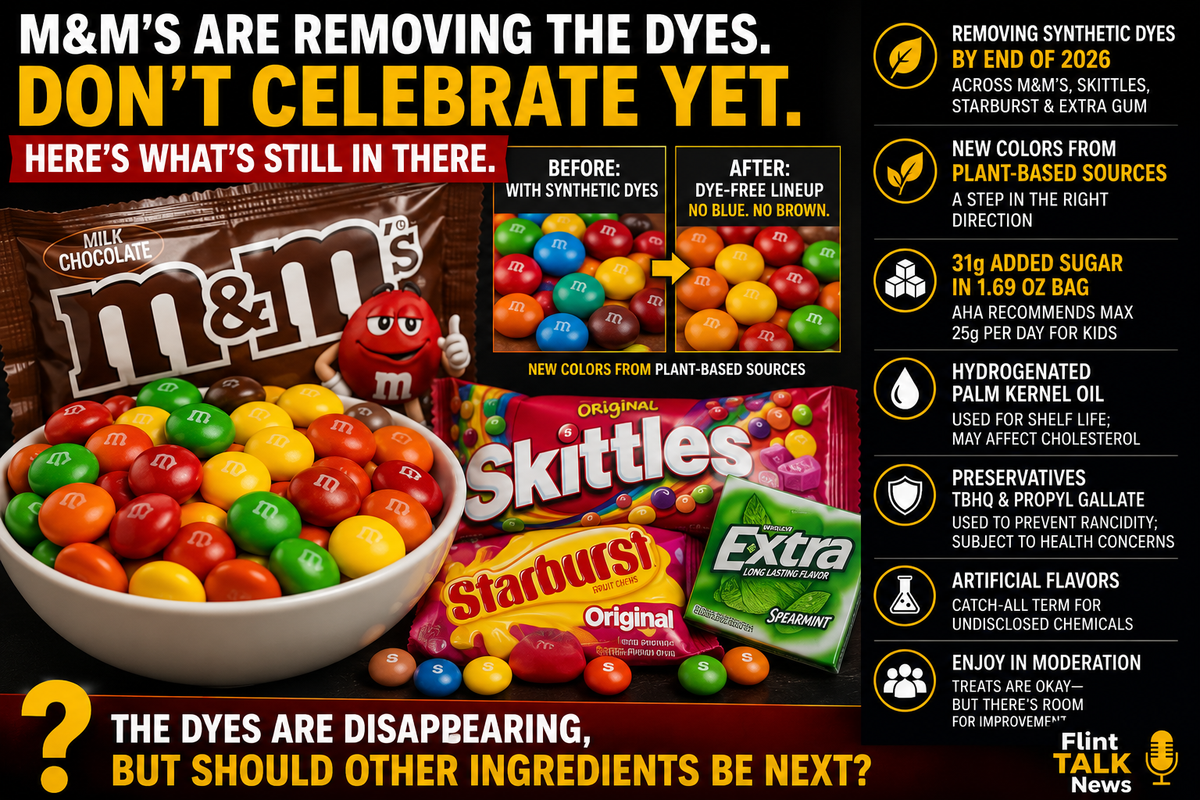
M&M'S ARE REMOVING THE DYES. DON'T CELEBRATE YET. HERE'S WHAT'S STILL IN THERE.
MCLEAN, Va. - Mars says it will begin selling a dye-free version of M&M's in August as part of the candy's 85th anniversary celebration. The company says it plans to remove synthetic dyes from its entire U.S. product line, including M&M's, Skittles, Starburst, and Extra Gum, by the end of 2026.
For many consumers, that sounds like a major health victory. Artificial dyes such as Red 40, Yellow 5, and Yellow 6 have faced criticism for years, and some European countries require warning labels stating they may affect children's activity and attention. The United States does not require those warnings.
Mars says the new M&M's will use plant-based color alternatives. Two familiar colors, blue and brown, will not be included because the company says it has not yet found natural replacements that match those shades.
Removing synthetic dyes is a step many health advocates have been calling for, and Mars is receiving praise for making the change. But nutrition experts note that food dyes are only one part of the overall ingredient list.
A 1.69-ounce package of Milk Chocolate M&M's contains 31 grams of added sugar. The American Heart Association recommends that children consume no more than 25 grams of added sugar per day. One package exceeds that recommendation.
The ingredient list also includes hydrogenated palm kernel oil, artificial flavors, soy lecithin, and preservatives such as TBHQ and propyl gallate in some varieties. All of these ingredients are approved for use in the United States, although some continue to be discussed and studied by health experts and consumer groups.
TBHQ, or tertiary butylhydroquinone, is commonly used to extend shelf life in processed foods. Propyl gallate is another preservative used to help prevent fats from spoiling. Both have been the subject of ongoing review and debate among regulators and consumer advocates.
Some observers also point to differences between products sold in Europe and those sold in the United States. European versions of M&M's have used different coloring systems and generally contain fewer synthetic additives because of differing food regulations.
Mars first announced plans to remove artificial colors from many products in 2016. Nearly a decade later, the company is now rolling out those changes across its U.S. brands.
The result is a candy that no longer contains synthetic food dyes, while still containing many of the ingredients that have traditionally been part of the product.
For most people, enjoying a package of M&M's once in a while is simply a treat. But now that Mars has addressed artificial dyes, will consumers begin asking whether other ingredients should be next?



Comments ()