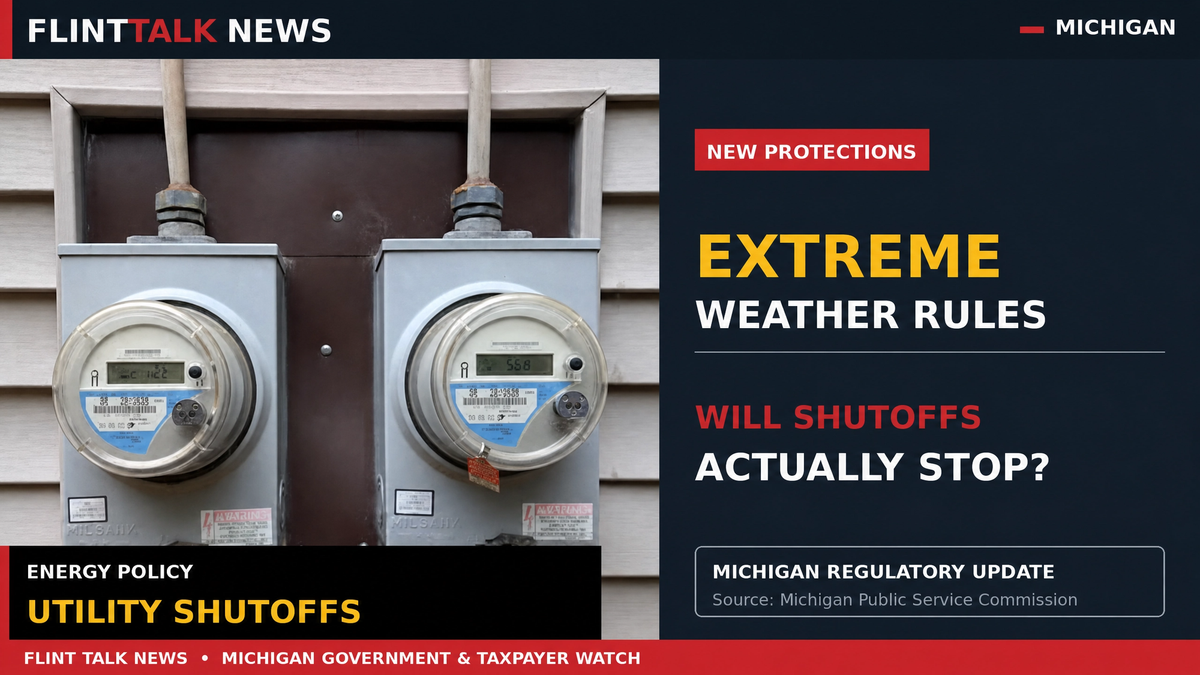
Michigan Orders New Extreme-Weather Utility Shutoff Rules. But Do They Go Far Enough?
LANSING, Mich. – Michigan utility regulators have ordered new statewide standards designed to stop electric and natural-gas shutoffs during dangerous heat and cold.
But there are major limits.
The new rules do not automatically reconnect customers whose service has already been shut off. Natural-gas companies may still disconnect customers during the summer months. And the new utility policies still must be filed, reviewed and approved before they fully take effect.
The Michigan Public Service Commission approved the new framework July 16, replacing a patchwork of different extreme-weather policies used by individual utilities.
Under the framework, MPSC-regulated electric and natural-gas utilities would suspend residential shutoffs when:
• Temperatures fall to 20°F
• Wind chills reach 0°F
• Temperatures reach 90°F
• Humidity triggers a National Weather Service extreme-weather advisory
Utilities would also pause shutoffs 24 hours before and after qualifying extreme-weather events and during consecutive extreme-weather events.
Until now, Michigan required utilities to have extreme-weather shutoff policies but did not impose one uniform standard.
That meant companies could use different rules.
DTE, for example, relied on forecasts showing certain extreme temperatures for consecutive days, while Consumers Energy used conditions that were actually recorded.
The new MPSC order is intended to create one clearer statewide framework for regulated utilities.
But it is not fully in place yet.
Utilities must submit updated policies by October 15, 2026. MPSC staff must review them by November 13, with the Commission later deciding whether each utility’s policy is approved.
Another major issue is what happens to people who have already lost service.
The order temporarily stops new shutoffs when extreme-weather conditions are triggered. It does not create a general rule requiring utilities to reconnect customers who were disconnected before the heat wave or cold snap began.
That means a household could already be sitting without electricity or gas when dangerous weather arrives and still not automatically qualify to have service restored.
Natural gas also has a major exception.
Gas utilities may continue disconnecting customers between May 1 and August 31 under the Commission’s framework.
Air quality is not included either.
The MPSC has directed staff to work with utilities on whether future protections should be triggered by dangerous air-quality conditions.
Michigan already has separate protections through programs such as the Winter Protection Plan, which can help qualifying seniors and low-income customers avoid shutoffs between November 1 and March 31. Those protections come with eligibility requirements and may still require payments toward outstanding bills.
The state is also separately reviewing protections for critical-care customers who depend on medical equipment or life-support systems at home.
Michigan’s new extreme-weather rules clearly strengthen protections against utility shutoffs.
But they are still temporary, weather-triggered protections.
They do not guarantee year-round protection.
They do not automatically restore power or heat once someone has already been disconnected.
And for some Michigan families, that may be the biggest gap of all.
Are these protections strong enough, or should Michigan go further when extreme weather puts lives at risk?



Comments ()