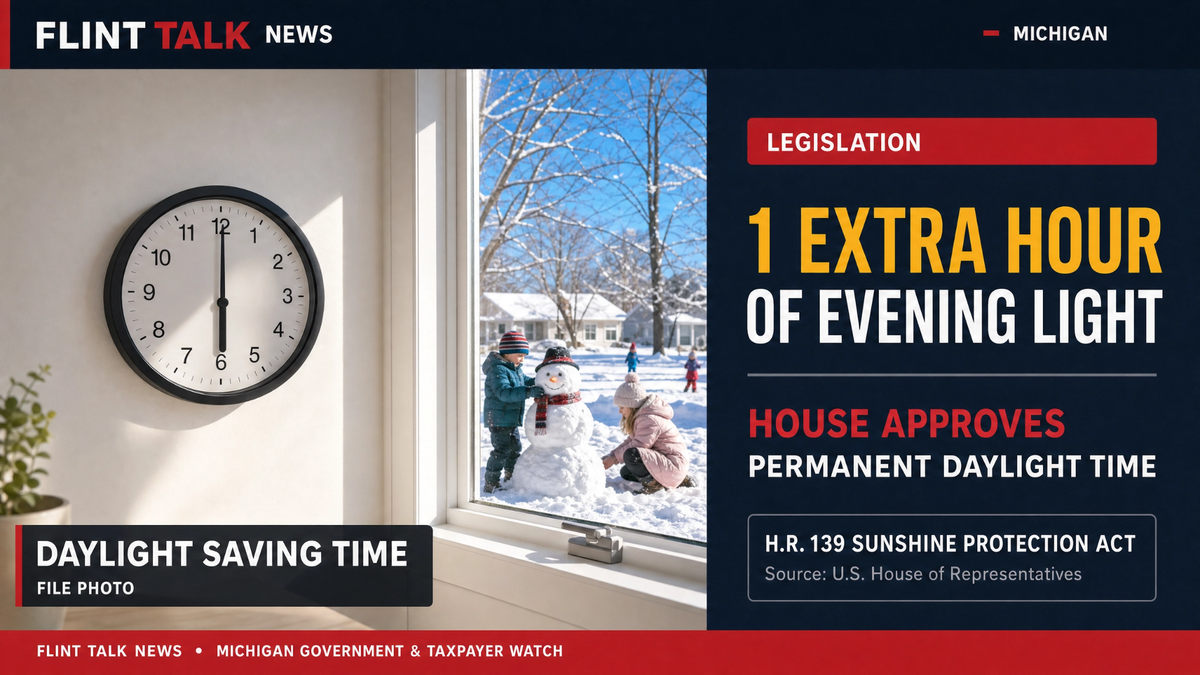
House Votes to Stop the Clock Changes, Giving Flint an Extra Hour of Evening Daylight
FLINT, MI — The U.S. House has approved legislation that would make daylight saving time permanent, finally offering a path to end the twice-yearly clock changes and giving working people more usable daylight when they get home.
The House passed the Sunshine Protection Act, H.R. 139, by a bipartisan vote of 308-117 on July 14, according to the official House roll call. If the Senate follows suit and the president signs the bill, today’s daylight saving time would become the new year-round standard. There would be no more “falling back” in November and no more 5 p.m. sunsets in the dead of winter.
For Flint residents, the practical benefit is obvious: more daylight when you are actually free to use it.
Under the current system, late December sunsets in Flint happen around 5 p.m. Most people are still at work, commuting, or just finishing school activities. By the time they get home, it is already dark.
If daylight saving time becomes permanent, that same sunset would shift to 6 p.m. It does not create more total daylight, but it moves an hour of winter sun from the early morning—when most people are asleep or already preparing for work—to the late afternoon. That means an extra hour of light for errands, outdoor exercise, walking the dog, or simply having part of the day left after clocking out.
The public appears ready for the change. A YouGov survey conducted in February 2026 found that 64% of Americans wanted to eliminate the twice-yearly time change. Given the choice, significantly more people preferred permanent daylight time (43%) over permanent standard time (28%). An earlier AP-NORC poll found an even stronger preference, with 56% favoring year-round daylight time.
Supporters of the House bill argue that later sunsets help local businesses, encourage children to play outside, and make evening commutes safer. Nineteen states have already passed laws supporting year-round daylight time if Congress allows it, according to the National Conference of State Legislatures.
The main objection comes from sleep specialists, who prefer permanent standard time. The American Academy of Sleep Medicine argues that morning light is better for human circadian rhythms. Critics also point out that permanent daylight time would push late-December sunrises in Flint to about 9 a.m., meaning students would wait for buses and morning commuters would travel in the dark.
But for many working families, the tradeoff is worth it. Most morning routines already happen in the dark or under artificial light, regardless of what the clock says. Giving up an hour of morning sun to gain an hour of usable evening daylight is a deal most Americans seem eager to make.
The bill still faces hurdles. Politico reported that the legislation has an uncertain path in the Senate, where some key Republicans have raised objections. But the House vote brings the country closer than it has been in years to stopping the clock changes.
The Question: Are you ready to stop changing the clocks and keep that extra hour of evening daylight year-round, or do you prefer the current system?





Comments ()