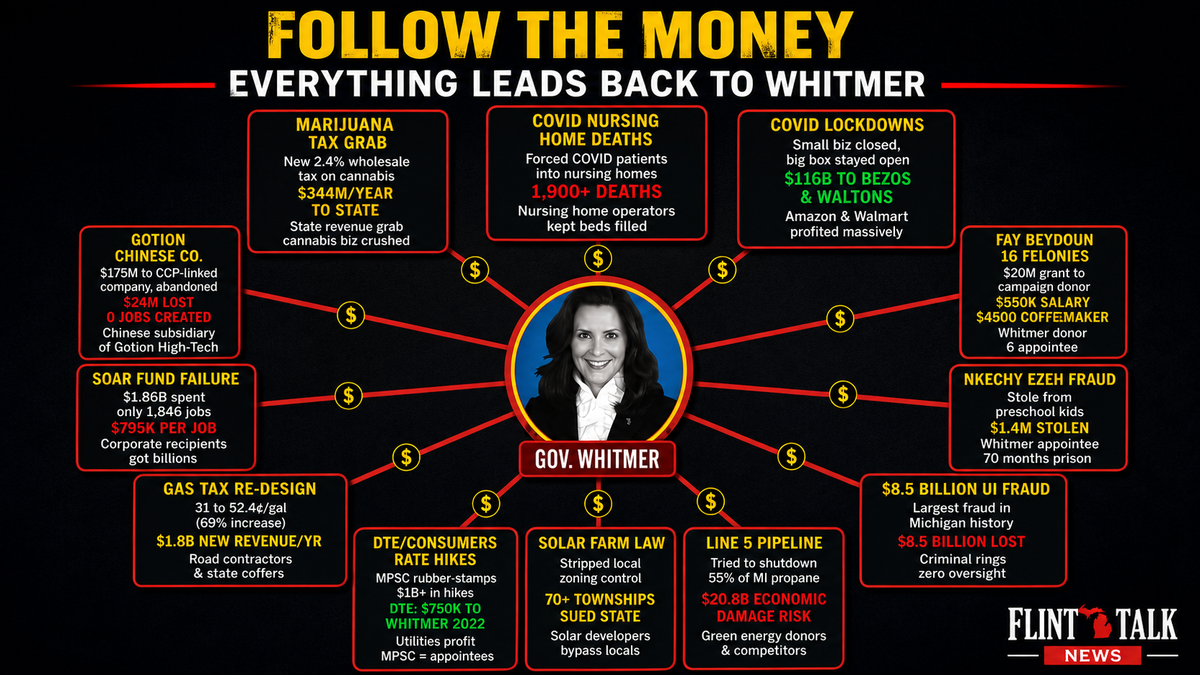
FOLLOW THE MONEY Everything Leads Back To Whitmer
FLINT, MI — Flint Talk took a closer look at some of Michigan’s biggest controversies involving taxpayer money, state policies, political appointments, corporate subsidies, and fraud cases tied to Governor Gretchen Whitmer’s administration since 2019. The investigation examines where billions of dollars went, who benefited, and how many Michigan residents were affected by the decisions.
FOLLOW THE MONEY Everything Leads Back To Whitmer
COVID NURSING HOME DEATHS
Michigan faced major backlash during the pandemic after COVID positive patients were placed into nursing homes housing elderly residents. More than 1,900 deaths were linked to outbreaks in long term care facilities while operators continued receiving funding tied to occupied beds.
COVID LOCKDOWNS
Thousands of Michigan small businesses were forced to shut down or severely limit operations during statewide lockdowns while major national chains remained open. Critics argued the restrictions devastated local businesses while large corporations and online retailers saw record profits.
FAY BEYDOUN CONTROVERSY
Businesswoman and Whitmer supporter Fay Beydoun became the center of a criminal investigation tied to a state funded grant program. Prosecutors alleged taxpayer money was connected to luxury spending including high priced travel, expensive office purchases, and other questionable expenses. The case resulted in multiple felony charges.
NKECHY EZEH FRAUD CASE
Former Whitmer appointee Nkechy Ezeh was sentenced in federal court after being accused of stealing more than $1.4 million tied to preschool education programs intended for children and families.
$8.5 BILLION UNEMPLOYMENT FRAUD
Michigan’s unemployment system was overwhelmed during the pandemic as criminal rings exploited the system for fraudulent claims. Investigators estimated the losses reached $8.5 billion, making it one of the largest fraud scandals in Michigan history.
LINE 5 PIPELINE BATTLE
The Whitmer administration attempted to shut down the Line 5 pipeline, which supplies a large percentage of Michigan’s propane and fuel needs. Critics warned the move could create major economic consequences and higher energy costs across the state.
SOLAR FARM LAW
Michigan lawmakers approved changes limiting local control over large scale solar projects. More than seventy communities challenged the law, arguing local zoning authority was stripped away in favor of state level approvals benefiting major developers.
DTE AND CONSUMERS RATE HIKES
DTE and Consumers Energy received approval for more than $1 billion in utility rate increases while political donations and campaign support tied to state leadership continued drawing criticism from opponents who questioned the relationship between regulators and utility companies.
GAS TAX INCREASES
Michigan drivers saw fuel taxes rise sharply over the past several years. Critics argued the increased costs generated billions in additional state revenue while residents continued dealing with high fuel prices and ongoing road complaints.
SOAR FUND SUBSIDIES
Michigan committed billions in corporate subsidy spending through the SOAR Fund program to attract large projects and employers. Critics pointed to the high cost per job created and questioned whether taxpayers received enough value in return for the incentives.
GOTION BATTERY PROJECT
The proposed Gotion battery project became one of Michigan’s most controversial economic development deals after concerns were raised over foreign ties, taxpayer incentives, and local opposition. Millions in public money were connected to the project before portions of the development stalled.
MARIJUANA TAX EXPANSION
Michigan’s marijuana industry faced additional tax pressure after lawmakers approved a new wholesale level cannabis tax tied to road funding. Business owners warned the added costs could hurt smaller operators already struggling in a competitive market.
With billions of taxpayer dollars involved, rising costs across Michigan, multiple fraud investigations, and years of controversial policies still being debated, many voters are now asking one question heading into November: where did all the money really go?
Comments ()