

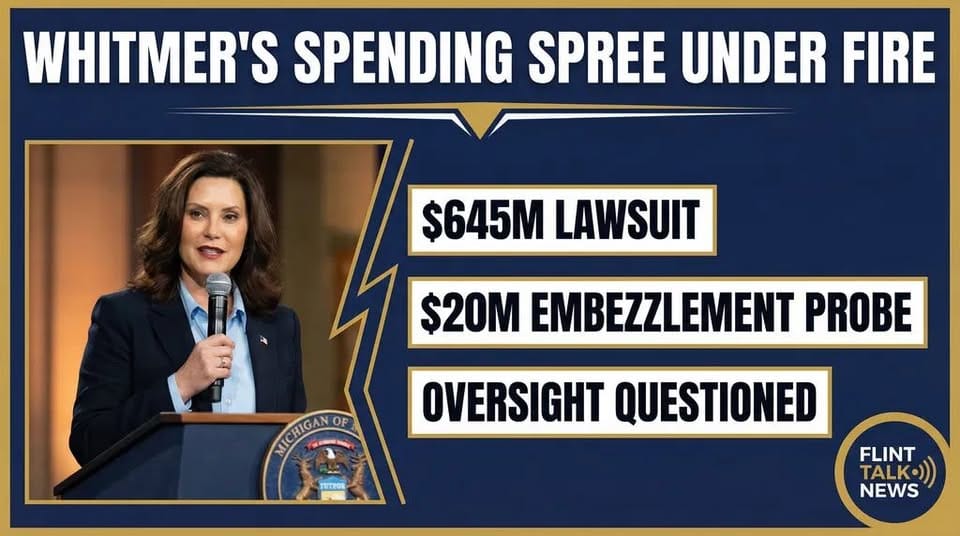
Whitmer's Spending Spree Under Fire: $645M Lawsuit and $20M Grant Embezzlement Probe
Governor's Administration Faces Legal Battle Over Controversial Spending While Embezzlement Investigation Raises Questions About Oversight
LANSING, MI - Governor Gretchen Whitmer's administration is facing a two-front political and legal assault over its spending practices. The Michigan House GOP has filed a lawsuit challenging $645 million in state spending, while a separate embezzlement investigation into a $20 million grant has raised serious questions about how the governor's office manages taxpayer money. The controversies paint a picture of an administration that has operated with minimal oversight and questionable accountability, according to critics who argue that Whitmer has used her executive authority to direct billions of dollars to projects and recipients with little transparency or legislative scrutiny.
The $645 Million Spending Battle
In January 2026, Michigan House Republicans sued to block $645 million in state spending that the GOP-led Appropriations Committee had previously cut from the budget. The lawsuit represents an unprecedented clash between the Republican-controlled House and the Democratic governor over spending authority. Here is what happened: House Republicans used their authority under state law to cancel $645 million in budget items they deemed wasteful or unnecessary. The Whitmer administration challenged the cancellation, arguing that the House action was unconstitutional. Attorney General Dana Nessel sided with the governor, declaring that the House's use of the law to cut spending was unconstitutional. But the House Republicans refused to back down. They filed a lawsuit seeking an injunction to prevent the state from spending the $645 million until the constitutionality of the House's actions could be determined in court. A judge initially sided with the House, blocking spending of a portion of the disputed funds. The legal battle is still ongoing, but what is clear is that the Whitmer administration wanted to spend $645 million that House Republicans believed was wasteful. The question of who is right remains in the courts, but the dispute has exposed the governor's aggressive spending agenda.
The $20 Million Grant Embezzlement Probe
While the spending lawsuit plays out, a separate investigation has raised even more serious concerns about the Whitmer administration's financial management. In 2025, an embezzlement probe was launched into a $20 million state grant that was diverted under questionable circumstances. According to reports, the $20 million was awarded as a legislative earmark, but the grant became the subject of an embezzlement investigation after it was discovered that the funds may have been misused. The investigation raised questions about whether the grant was properly overseen and whether the Whitmer administration had adequate controls in place to prevent fraud. Whitmer herself acknowledged the controversy, telling reporters in July 2025 that she was "very troubled" by the embezzlement allegations. Her chief of staff allegedly apologized for the grant diversion, suggesting that the administration recognized something had gone wrong. But the apology did not answer the fundamental question: How did a $20 million state grant become the subject of an embezzlement investigation? What controls were missing? And why did it take an investigation to uncover the problem?
A Pattern of Questionable Spending
The $645 million spending battle and the $20 million embezzlement probe are not isolated incidents. They reflect a broader pattern of spending practices by the Whitmer administration that critics argue lack transparency and proper oversight. The Michigan Economic Development Corporation, which administers state business grants, has been at the center of several controversies. In one case, the MEDC chief claimed to be unaware of a $20 million state business grant that had become the subject of an embezzlement investigation, raising questions about how the agency manages large grants. Additionally, the Whitmer administration has used what critics call "sneaky budget practices" to award billions of dollars to private corporations. According to the Mackinac Center for Public Policy, the now-standard practice by which Lansing awards billions of taxpayer dollars to private corporations violates longstanding language in state law.
Defunding Oversight
To make matters worse, the Whitmer administration has proposed defunding key oversight offices. In 2024, House Republican Leader Matt Hall condemned the governor's proposal to drastically reduce funding for the nonpartisan Office of the Auditor General, which is responsible for auditing state spending and ensuring accountability. If the governor's proposal had been enacted, it would have further weakened the state's ability to detect fraud, waste, and abuse in state spending. The fact that the administration even proposed such cuts suggests a desire to reduce scrutiny of its spending practices.
What the Governor Says
The Whitmer administration has defended its spending as necessary to meet the state's needs and fulfill campaign promises. The governor has argued that the House GOP is using its budget authority for political purposes rather than legitimate fiscal concerns. But the administration's defense does not address the fundamental issues raised by the $645 million spending battle and the $20 million embezzlement probe. How can taxpayers have confidence in the governor's spending decisions when $20 million in grants become the subject of embezzlement investigations? How can the House be expected to approve budgets when the governor spends money that has been cut?
The Broader Question
The controversies surrounding Whitmer's spending raise a broader question about executive power and accountability. In Michigan, the governor has significant authority to direct spending and manage state agencies. But that authority must be exercised with transparency and proper oversight. The $645 million spending battle and the $20 million embezzlement probe suggest that the Whitmer administration has not always exercised that authority responsibly. Whether the courts will agree remains to be seen, but the political damage has already been done. For Michigan taxpayers and voters, the message is clear: The Whitmer administration's spending practices deserve far more scrutiny than they have received.





Comments ()