

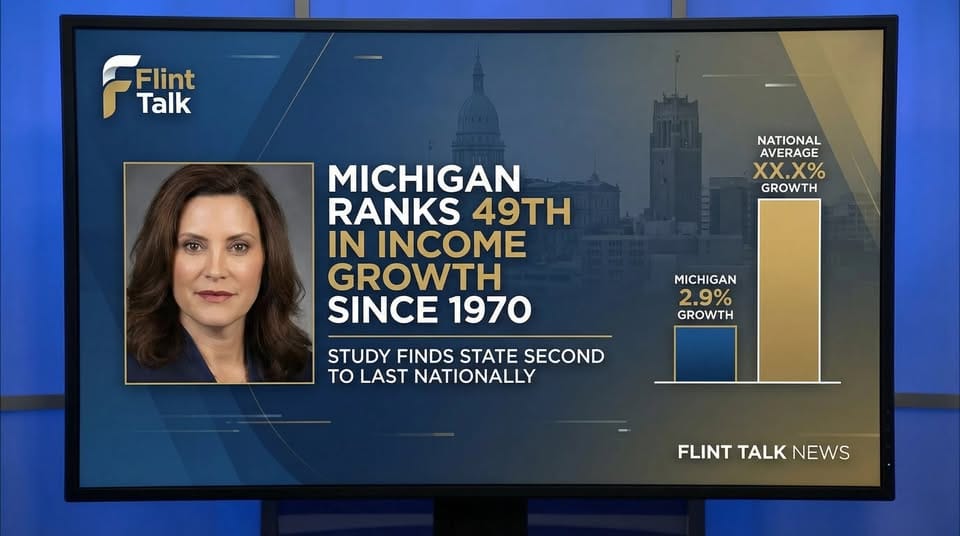
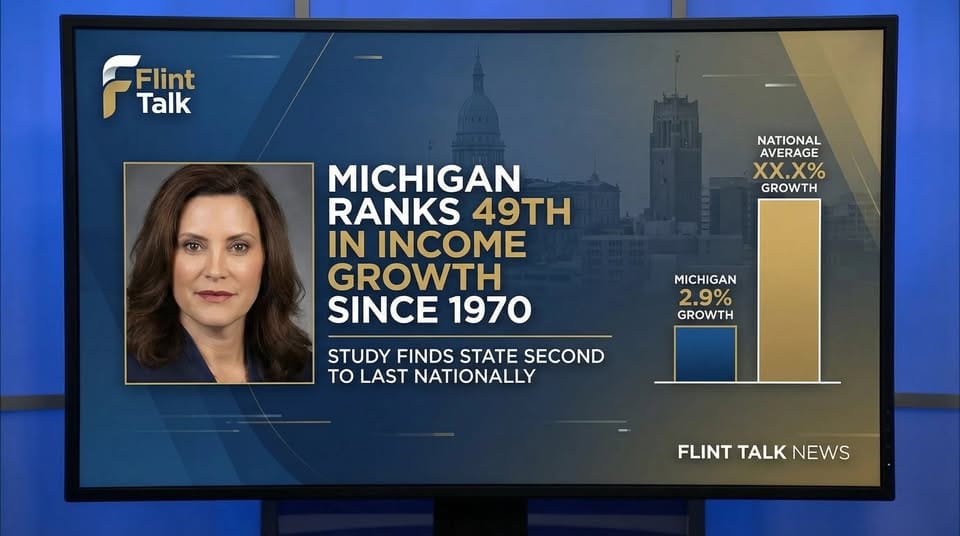
Whitmer Era Under Scrutiny as Michigan Ranks Near Bottom in Income Growth Since 1970
Flint, MI – A recent study by the left-leaning Urban Institute has cast a stark light on Michigan's long-term economic performance, revealing the state ranks second to last nationally for inflation-adjusted household income growth since 1970. This finding is prompting renewed scrutiny of economic policies, including those under Governor Gretchen Whitmer's administration.
The policy brief, titled "Is Your State Better Off Now Than It Was Fifty Years Ago?" and published in January 2026, indicates that Michigan's household income grew by a mere 2.9% between 1970 and 2023. Only West Virginia, with a negative 0.4% growth, fared worse. This contrasts sharply with states like Utah and Colorado, which led the nation in income growth over the same period.
Economists and business leaders have voiced concerns for years about Michigan's economic trajectory. Lou Glazer, president
of Michigan Future Inc., and University of Michigan economist Donald Grimes previously warned that Michigan could become the 48th poorest state by 2047 if current trends in per capita income persist. Glazer noted that per capita income has reached its lowest relative point during Governor Whitmer's second term, according to a report by The Midwesterner.
Further analysis reveals that Michigan's job growth since Governor Whitmer took office ranks 38th among states, at 2.2%, significantly trailing states like Idaho, which saw a 17.6% increase. Despite $6.9 billion in authorized business subsidies during her tenure, Michigan is projected to lose over 18,000 manufacturing jobs in the coming decade, even as national manufacturing employment is expected to rise.
Adding to the concern, a recent poll by the Detroit Regional Chamber found a disconnect between public perception and economic reality. Michigan voters, across both major political parties, generally believe the state performs
averagely (ranking between 25th and 29th) on key metrics such as college degrees, student reading performance, average income, attracting high-tech jobs, and unemployment rate. In reality, Michigan ranks 33rd for college degrees, 44th for student reading, 40th for average income, and 45th for attracting high-tech jobs and unemployment.
Sandy Baruah, CEO of the Detroit Regional Chamber, emphasized the urgency of the situation, stating, "In just one generation, Michigan has fallen from a top 10 or 20 state to a bottom 10 state in per capita income and educational achievement, which is not a recipe for long-term economic success." Richard Czuba, president of the Glengariff Group, suggested that Michigan's continued reliance on a manufacturing identity, rather than embracing a knowledge-based economy, contributes to its economic struggles.
These findings present a critical challenge for Michigan's leadership and future economic strategy. As the state approaches the 2026 gubernatorial election, political observers suggest that candidates will face increasing pressure to articulate clear plans for reversing these long-term economic trends and improving the state's competitive standing.





Comments ()