

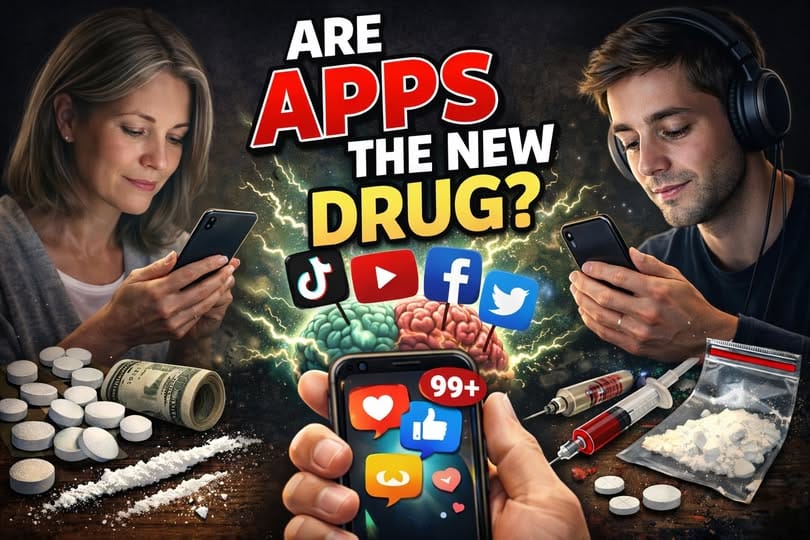
Online apps and digital dopamine: the drug nobody thinks they are taking
Nobody would say, “I’m just going to do a little cocaine before bed.”
But millions of people say, “I’ll just scroll for a minute,” and somehow wake up an hour later watching videos they do not even remember liking.
That is because modern apps are not just tools. They are dopamine delivery systems.
Platforms like TikTok, YouTube, Facebook, and X are built on the same core principle used by addictive drugs: deliver a fast, unpredictable reward, then make it frictionless to get the next hit.
One swipe.
One refresh.
One more clip.
Just like drugs, you never know exactly how strong the next dose will be, and that uncertainty is the point.
The science part, without pretending everyone reads studies
Doctors and behavioral researchers have been saying for years that variable reward systems trigger the same brain pathways as gambling and substance use. When your brain does not know what is coming next, it releases dopamine in anticipation, not just in reward. That keeps you pulling the lever.
Infinite scroll is not convenience. It is the digital equivalent of removing the “stop” sign.
Autoplay is not helpful. It is the digital equivalent of pouring the next drink before you ask.
Push notifications are not reminders. They are withdrawal pings.
And this does not only affect kids. Adults with jobs, mortgages, and arthritis are just as capable of doomscrolling themselves into a fog.
“But I can quit anytime” is always how addiction sounds
Every addictive system works best when the user believes they are in control.
You are not forced to scroll.
You are invited. Repeatedly.
And politely.
With just enough novelty to keep you from leaving.
That is why people feel drained, unfocused, irritable, and strangely unsatisfied after long sessions online. You got plenty of stimulation, but no resolution. Dopamine without closure is exhausting.
Where the EU fits into this, quietly
This is where the European Union enters the picture, not as the main character, but as the adult in the room asking an awkward question.
EU regulators recently told TikTok that certain design choices, like infinite scroll, autoplay, and aggressive recommendations, may violate EU digital safety rules and could result in large fines unless changes are made.
That matters, not because TikTok is unique, but because it is not unique at all.
The same design logic exists across nearly every major platform. The EU just happened to say out loud what users already feel: these apps are engineered to be habit-forming, not neutral.
The uncomfortable comparison nobody wants to admit
No one thinks social media is the same as heroin.
But structurally, it behaves closer to a low-dose stimulant than a harmless utility.
- Small hits.
- Frequent use.
- Escalation over time.
- Difficulty stopping.
- Irritability when interrupted.
- “Just five more minutes” turning into an hour.
The difference is this drug is legal, socially encouraged, and fits in your pocket.
The bottom line
This is not about banning apps or pretending the internet was better in 2006. It is about acknowledging reality.
Modern platforms are designed to keep you consuming, not to help you decide when you are done. The EU noticed. Researchers noticed. Users feel it every night when they put the phone down and think, “Why did I just do that for so long?”
If this were any other product, we would already be arguing about warning labels.






Comments ()