

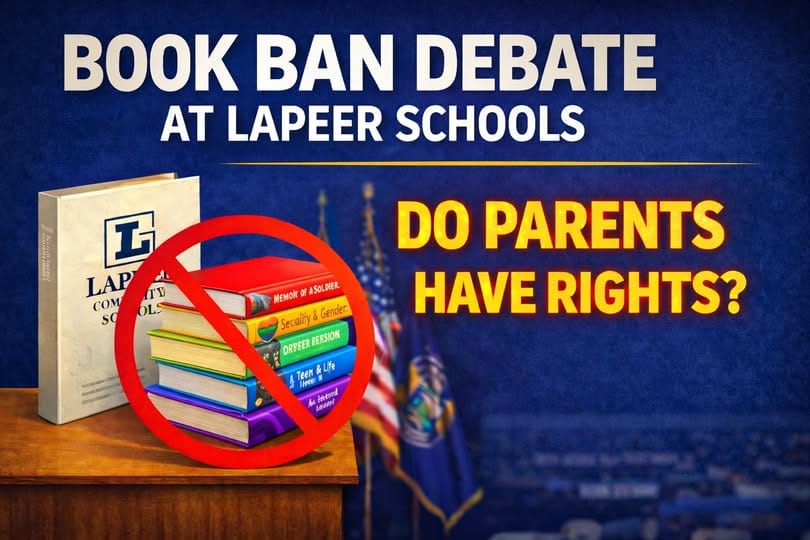
Most Recent Lapeer Parents Reignite Michigan’s Book Debate as “Banned” vs “Removed” Language Fuels Backlash
Michigan school districts are again facing heated debates over parent-initiated book removals, with the most recent flashpoint involving parents in Lapeer who asked school officials to reconsider what materials are made available to children in school libraries.
In Lapeer Community Schools, administrators removed 59 books from school libraries and classrooms after parents and community members raised concerns about content dealing with gender identity, PTSD, alcohol use, and suicide. School officials did not release a public list of the titles, and reporting to date confirms that no specific book names have been disclosed. At a packed board meeting, residents were split, with some parents supporting the removals as a matter of child protection, while others criticized the process and warned about limiting access to ideas.
Across Michigan, these disputes are often described in headlines as “book bans,” but that word itself has become one of the central points of contention.
“Banned” or “Removed”
Groups such as PEN America and the American Library Association frequently classify school library removals as “book bans,” arguing that when a title is no longer accessible in a school setting, it is effectively banned from that educational environment.
Parents pushing for removals strongly disagree with that framing. They argue that calling these actions “bans” is misleading and inflammatory. The books are not illegal, not destroyed, and not restricted from public libraries, bookstores, or private ownership. Parents can still buy them, borrow them elsewhere, or even read them to their children at home as bedtime stories if they choose. What is being debated, they say, is what schools should actively provide to children during the school day, not whether adults are allowed to read certain books.
A Statewide Pattern
The Lapeer situation fits into a broader Michigan pattern where disputes are driven by parent complaints, not government crackdowns. According to PEN America’s own tracking, Michigan recorded no official book bans in the 2024–2025 school year, even as thousands were reported nationwide.
Earlier, isolated cases included:
Hudsonville Public Schools (2023), where the board removed Jarhead by Anthony Swofford after parent objections.
A southwest Michigan district (2025) that removed Ponies by Kij Johnson.
Prior challenges between 2021 and 2023 involving titles such as Gender Queer, All Boys Aren’t Blue, and The Bluest Eye, often in public libraries rather than K–12 schools.
In each case, the books remained legal and accessible elsewhere. The disputes centered on age-appropriateness and school endorsement, not censorship in the broader society.
Parental Rights at the School Door
For many parents in Lapeer and beyond, the issue comes down to a basic question: why shouldn’t parents be able to decide what their children are exposed to in school? They argue that sending children to a public school does not mean parents surrender their parental rights at the door. Schools act in place of parents during the school day, not instead of parents.
From this perspective, asking schools to remove or relocate certain materials is not about controlling other families, but about ensuring that taxpayer-funded school libraries reflect community standards for minors. Parents who want their children to read those books remain free to provide them at home.
An Ongoing Divide
Critics of removals warn that allowing parents to influence library collections risks narrowing perspectives and setting precedents that could sideline uncomfortable but important topics. Supporters counter that schools are not neutral marketplaces of ideas and already make countless judgment calls about what is appropriate for different ages.
As Michigan districts like Lapeer continue to navigate these disputes, one thing remains clear: the argument is no longer just about books themselves, but about language, parental authority, and whether “banned” accurately describes decisions that still leave families free to read whatever they choose outside the classroom.






Comments ()