

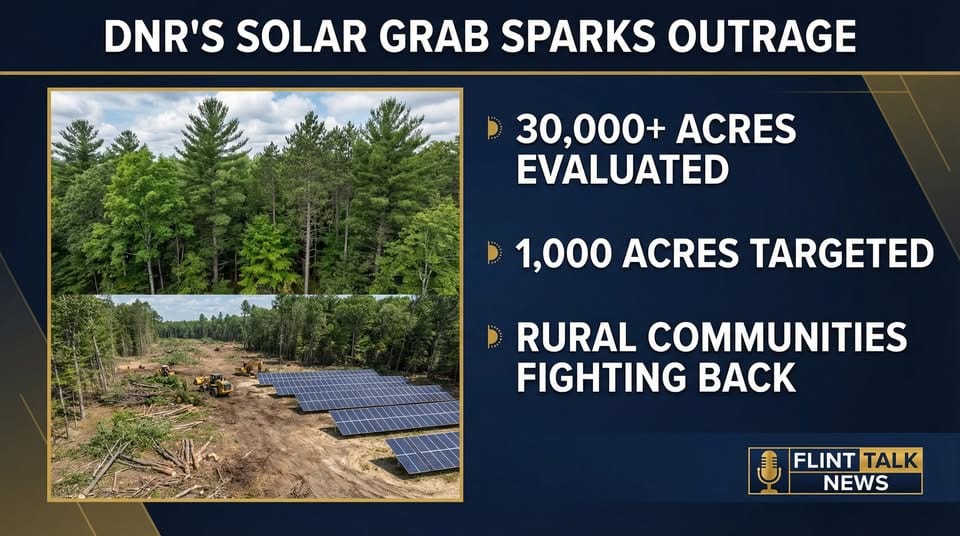
DNR's Solar Grab Sparks Outrage: Whitmer's Green Agenda Paves Over Michigan's Forests
State Plans to Lease Thousands of Acres of Public Forest Land for Solar Farms While Rural Communities Fight Back
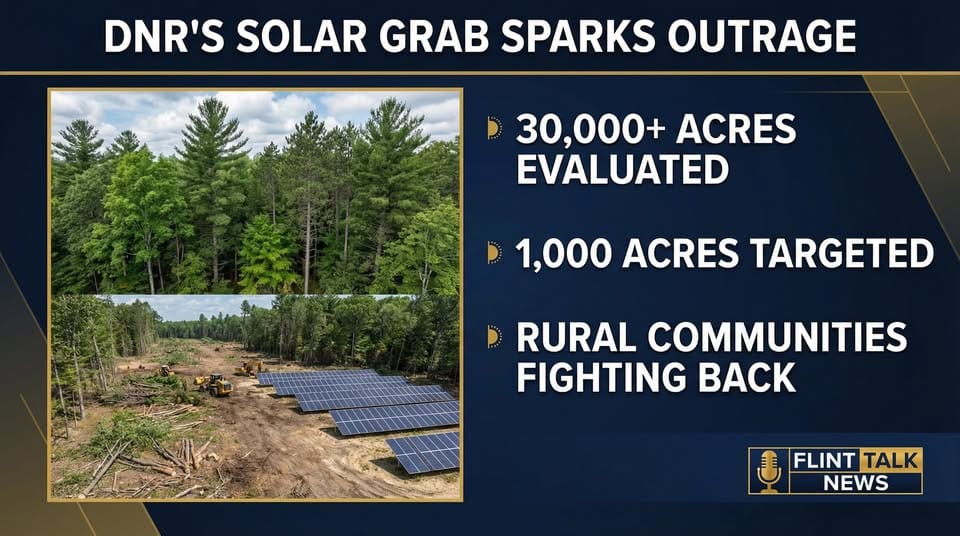
LANSING, MI - The Michigan Department of Natural Resources is moving forward with plans to lease thousands of acres of state-owned forestland for solar development, a move that has sparked fierce opposition from environmental groups, rural communities, and lawmakers who question whether the state is sacrificing Michigan's natural heritage for renewable energy credits. The DNR has evaluated over 30,000 acres of state-managed land for potential solar development as part of Governor Gretchen Whitmer's push to meet the state's 100 percent clean energy standard by 2040. While most of those acres have been deemed incompatible with solar energy, the agency continues to identify sites suitable for utility-scale solar projects, including some of Michigan's most productive forestland.
The Gaylord Controversy
The clearest example of the conflict came near Gaylord, where the DNR proposed leasing 420 acres of state forest for solar development. The plan would have required clearing trees and converting productive forest into a solar farm. Public outcry was immediate and intense. Environmental advocates, local residents, and community leaders questioned why the state would destroy forest habitat to generate renewable energy when other options existed. After months of public pressure, the DNR suspended the Gaylord project in February 2025. But the agency did not abandon its broader solar agenda. Instead, it continued evaluating other sites across the state, and by May 2025, the DNR announced that another 1,000 acres of state forest were being considered suitable for solar development.
The Real Cost of Solar
What the Whitmer administration does not emphasize is the environmental cost of converting forest to solar farms. Michigan's state forests provide critical habitat for wildlife, carbon sequestration, and recreational opportunities. They also generate revenue through timber harvesting and hunting licenses. Converting these forests to solar farms eliminates these benefits permanently. The solar industry argues that utility-scale solar is necessary to meet Michigan's clean energy goals. But critics point out that the state has millions of acres of already-disturbed land, including brownfields, industrial sites, and agricultural land that could accommodate solar development without destroying forests.
Rural Communities Push Back
Rural Michigan communities are increasingly vocal about their opposition to large-scale solar development. In December 2025, residents of Iosco Township rejected a DTE Energy proposal to install solar panels on 3 square miles of rural, farming community land. The township board voted unanimously against the project after hearing from residents who expressed concerns about the loss of farmland and rural character. Similar opposition is emerging across the state. A proposed nearly 2,000-acre solar farm in Zeeland and Jamestown townships continues to spark strong reactions from residents and local officials. Community groups cite the destruction of farmland and rural community heritage as reasons to oppose the development.
Whitmer's Renewable Energy Push
The solar expansion is part of Whitmer's broader renewable energy agenda. The governor has promoted policies that ease restrictions on solar farm development and has secured federal funding to support clean energy projects. In July 2024, Whitmer announced a $129.1 million investment from the Biden-Harris administration to help Michigan meet its clean energy standards. But the push for renewable energy is coming at a cost. An estimated 17,000 acres in Michigan are currently used for wind and solar energy, with projections suggesting another 117,000 to 243,000 acres could be converted to renewable energy development over the next two decades.
The Data Center Connection
Adding to the controversy is the connection between solar development and data center expansion. Large technology companies are increasingly locating data centers in Michigan and demanding renewable energy sources to power them. This has created pressure on the state to rapidly expand solar capacity, even on public lands. The combination of solar farms and data centers represents a fundamental transformation of Michigan's landscape and economy. Rural communities that have relied on agriculture and forestry for generations now face the prospect of their land being converted to industrial renewable energy and data processing facilities.
What Happens Next
The DNR has halted new utility-scale solar leases on state forestland as of May 2025, but this is described as a temporary measure while the agency evaluates its policies. The fundamental question remains: Will Michigan pursue its clean energy goals by developing renewable energy on already-disturbed land, or will it continue converting forests and farmland to solar farms? For rural Michigan residents and environmental advocates, the answer is clear. The state should prioritize solar development on brownfields, industrial sites, and other already-disturbed land before touching a single acre of productive forest or farmland. Governor Whitmer's administration has not yet indicated whether it will change course on solar development policy. But the growing opposition from rural communities and environmental groups suggests that the political pressure to protect Michigan's forests and farmland is mounting. The battle over Michigan's land use is just beginning.




Comments ()