

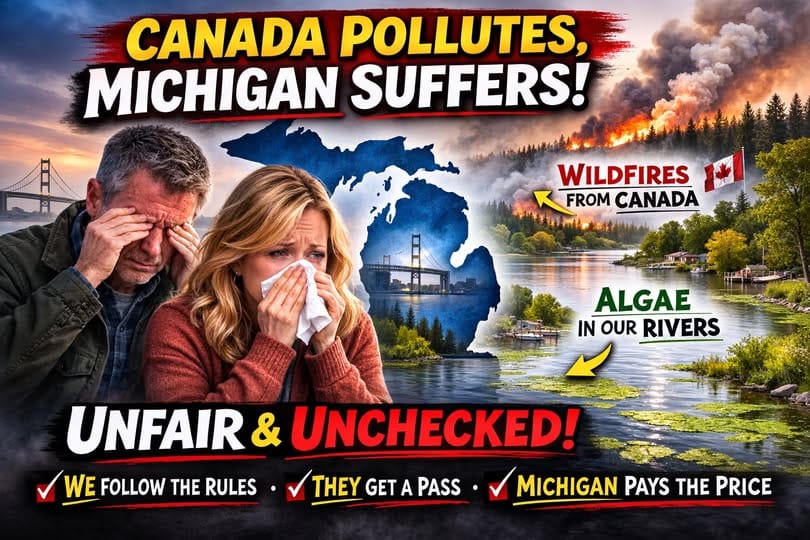
Canada Gets a Free Pass and Michigan Pays the Price
Michigan is choking on dirtier air and watching shared waterways suffer while Canada escapes pollution standards that would never be tolerated in the United States. The U.S. enforces strict limits through the Environmental Protection Agency, but Canada does not operate under an equivalent enforcement regime with the same penalties. As a result, pollution originating north of the border can drift into Michigan without fines, legal consequences, or meaningful accountability for the damage done here.
When Canadian wildfire smoke pours into Michigan, air quality alerts go up and breathing becomes harder, yet there is no enforcement mechanism that forces Canada to change course. Agreements like the Canada United States Air Quality Agreement rely on cooperation rather than punishment. When Canada crosses the line, nothing happens, while Michigan residents deal with the health and environmental fallout.
The problem does not stop with the air. Shared waters such as the Great Lakes are supposedly protected by joint agreements, but Canadian runoff and industrial pollution are often addressed on slow timelines with little pressure to act. U.S. facilities would face fines, lawsuits, or shutdowns for similar impacts, yet Canadian operations continue under weaker standards while Michigan absorbs the consequences.
The United States tightens rules, enforces them, and pays the price, while Canada gets a pass on air and water pollution that does not respect borders. How long should Michigan be expected to live with that imbalance?




Comments ()