

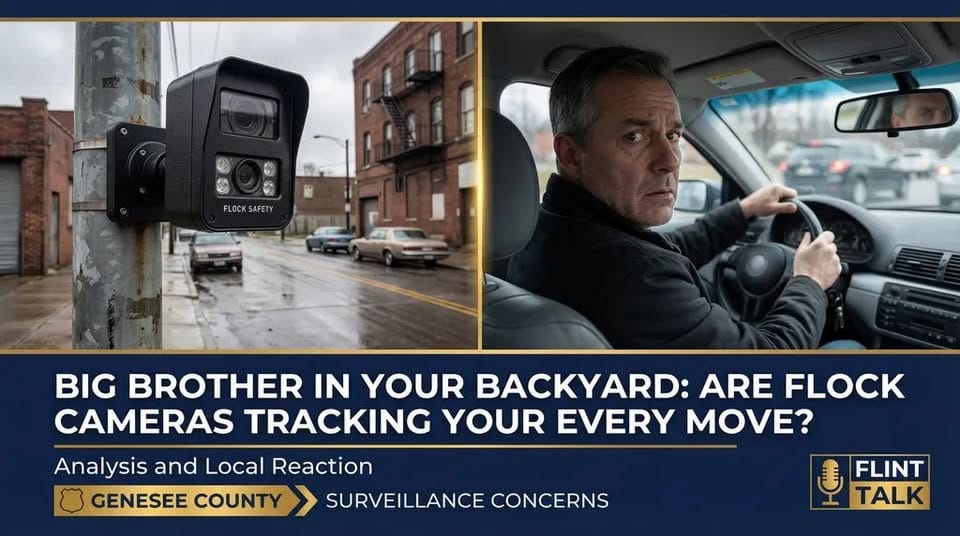
Big Brother Cameras Expand Across Flint Raises Questions About Privacy and Surveillance
FLINT, MI – A growing network of license plate reader cameras across Flint and Genesee County is tracking vehicle movements daily, recording locations, times, and vehicle details, as officials push for more installations while residents and civil rights groups question whether the expansion crosses the line into unconstitutional surveillance.
Across Flint, officials have looked at adding 31 more cameras to the 62 already in place, a proposal costing close to $200,000. Genesee County is running a separate system with at least 30 cameras. These systems, largely tied to Flock Safety, do more than read plates. They log vehicle make, model, color, and unique features, along with exact timestamps and locations, creating a searchable database accessible to law enforcement agencies nationwide.
Local police departments describe the cameras as a force multiplier used to solve crimes, recover stolen vehicles, and locate missing persons. At the same time, Michigan does not have consistent statewide rules governing how long this data is stored or who can access it, leaving policies up to local agencies.
Civil liberties groups, including the ACLU of Michigan, state that the system collects and stores location data on drivers who are not suspected of any crime. Concerns focus on the potential to track where people go, including medical visits, religious services, or political events.
Pushback has already started locally. In January, the Genesee County Board of Commissioners delayed action on renewing contracts tied to the camera network. Commissioner Shaun Shumaker raised concerns about how the data is secured and whether it is shared with outside groups or federal agencies. Reports from independent investigations have indicated that similar systems have been used by police in other areas for immigration related searches.
At the state level, lawmakers in Lansing have introduced House Bills 5492 and 5493 to regulate the systems, including limiting how long data on drivers not tied to crimes can be stored to 14 days. Those bills have not yet passed.
The cameras continue to expand while rules are still being debated. Are these systems a necessary tool for public safety or a form of surveillance that tracks everyday citizens without cause? What do you think?


Comments ()